 Celebrate with up to 80% off
Is AgeGO safe? Privacy, legitimacy, and data protection explained



AgeGO is an age-verification service you may have come across recently while trying to access online content. It can ask for sensitive information, such as your passport or credit card details, depending on your region, which may raise concerns about the service's safety.
The good news is that AgeGO is a legitimate company that states that it operates in line with established security and data protection standards. However, sharing sensitive data always carries a certain level of risk.
Is AgeGO safe to use?
AgeGO is a legitimate age-verification system used by online platforms that need to confirm a user's age before granting access to restricted content. Services that use AgeGO may include social media apps, gaming platforms, and adult websites.
If you haven't encountered it before, it's likely because age verification has only become more common in recent years. Stricter online safety rules have been introduced in several regions. In the U.K., for example, the Online Safety Act has led to stronger requirements for age verification on platforms that host or distribute adult or age-restricted content. In the U.S., some states have passed similar laws, such as H.B. 1181 in Texas.
What information does AgeGO collect, and how does it work?
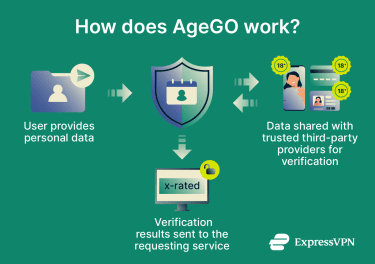 AgeGO offers several ways to prove your age, depending on your region, and each method requires you to provide different types of data. This data is then processed by third parties, which provide confirmation.
The service's age verification methods include:
- Selfie estimation: You take a selfie, which is analyzed to estimate your age based on facial recognition, liveness detection, and image quality. You may be asked to scan a government-issued ID using your phone or webcam if estimation isn't possible.
- Selfie + ID: In addition to taking a selfie, you upload a government-issued photo ID, such as a passport or driver's license, to confirm your date of birth.
- Credit card: You enter your credit card details, such as your card number, expiration date, and CVC/CVV. This method relies on the assumption that cardholders are generally adults and is only available in countries where holding a credit card implies the user is over 18.
- Digital ID: You create a digital ID card through a third-party app called Yoti, an identity verification service. Setting up a Yoti ID requires a selfie and a government-issued photo document.
How AgeGO handles your personal data
AgeGO states that it's compliant with data protection regulations in the regions where it operates.
Its website provides a data protection registration certificate from the Information Commissioner's Office (ICO). The website also states that AgeGO is compliant with the General Data Protection Regulation (GDPR), which sets rules for how personal data is collected, used, stored, and protected within the European Economic Area (EEA).
Additionally, AgeGO says that it follows principles such as data minimization when handling sensitive personal data. This means it collects, processes, and retains only the minimum amount of data it needs to perform its functions.
According to AgeGO's privacy policy, your personal data is only shared with third parties that play a role in carrying out the age verification (so not advertisers or data brokers).
AgeGO's third-party providers
The third-party providers AgeGO relies on include:
| Provider | Role |
| Yoti LTD | Digital ID-based identity and age verification |
| Klippa App B.V | Processing of identity documents for ID-based verification |
| Amazon Web Services EMEA SARL | Processing associated with selfie-based verification and selfie + ID face matching |
| Shift4 Payments LLC | Processing of credit card data for age verification |
The privacy policy states that these providers operate under contractual requirements to:
- Process the data they receive for the purpose of providing age verification services.
- Implement appropriate technical and organizational security measures to protect the data.
- Handle the data in accordance with applicable data protection laws.
Once age verification is completed, AgeGO says that it shares the result and only the result with the service requesting it (not any of the personal data that underlies it).
AgeGO and data retention
AgeGO's policy explains that the service doesn't store your ID, selfie, or any other personal data that it collects. That data is processed solely by the third-party providers it works with. However, these providers may retain your data for a period of time after the verification process is completed.
| Provider | How long is your data retained? |
| Yoti LTD | Based on Yoti's privacy policy (until you delete your Yoti account) |
| Klippa App B.V | Up to 1 hour |
| Amazon Web Services EMEA SARL | Up to 1 hour |
| Shift4 Payments LLC | No exact time provided, but in line with Payment Card Industry Data Security Standards (PCI DSS) |
Facial analysis vs. facial recognition
AgeGO's documentation uses both "facial recognition" and "facial analysis" terminology when describing its selfie-based age verification methods, but it doesn't say which technologies are used in each part of the process. While the terms are sometimes used interchangeably in public discussions, they can refer to different types of facial-processing systems.
Facial recognition is designed to identify or verify a specific individual by comparing facial features against stored images or biometric templates. It's commonly used in contexts such as device authentication and surveillance, where the goal is to confirm a person's identity.
Facial analysis, by contrast, doesn't attempt to determine who a person is. Instead, it evaluates a person's facial features to estimate attributes such as age, gender, or emotional state.
AgeGO privacy considerations
Sensitive nature of the data involved
Depending on the verification method, users may be required to submit highly sensitive information such as government-issued IDs or payment card details. This type of data carries inherent risk because, if exposed or improperly accessed, it could potentially be misused for identity theft or fraud.
Data sharing and third parties
AgeGO relies on external providers to carry out parts of the verification process. This means sensitive data is handled by multiple independent systems, increasing the number of potential points where technical or security issues could occur.
How to protect your privacy when using AgeGO
One option is to create an AgeGO account. This preserves your verification status, so you don't have to repeatedly submit sensitive information.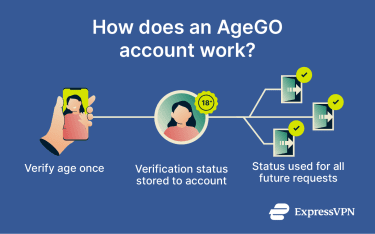
AgeGO's privacy policy says it stores limited account data: your verification status, an encrypted email address, and your account creation date. This information is generally less sensitive than identity documents. Additionally, you can delete this data by deleting your AgeGO account.
If you prefer to stick with one-time verification, AgeGO's selfie-based age verification generally requires the least amount of evidence to be submitted. That said, it still involves facial-image data, which may be considered sensitive personal information. It also involves agreeing to this data being processed and analyzed by Amazon Web Services (AWS), which AgeGO lists as a provider involved in selfie verification.
FAQ
Why am I suddenly being asked to verify my age?
Is AgeGO free to use?
How long does AgeGO verification take?
Can you delete your AgeGO data?
However, the service's verification methods involve your information being sent to third-party providers, who perform the actual checks. In some cases, you may be able to contact these providers directly to request deletion of your data. Companies are also sometimes required to retain certain information for a limited period, depending on their own policies.
Is AgeGO required by law?
What alternatives are there to AgeGO?